DTCC and Chainlink publish joint Sibos 2026 presentation specifying the Collateral AppChain architecture, an 11-step cross-chain repo workflow and DTCC's quantified business case
EV-085 · DTCC Digital Assets / Chainlink Labs · 2026-09-29 · Evidence class: documentation · Confidence 94%
Dan Doney; Sergey Nazarov; Ryan Lovell — CTO DTCC Digital Assets; CEO Chainlink Labs; Director of Capital Markets Chainlink Labs
In plain English
In plain terms: DTCC and Chainlink presented together at the banking industry's main conference and showed exactly how their collateral system would work. The example: a pension fund lends cash to a hedge fund, which puts up tokenized Microsoft shares as security. Chainlink's CRE coordinates the steps, CCIP moves the shares from Ethereum to DTCC's chain, price feeds continuously check the shares are still worth enough, and once that checks out the cash is released. DTCC's own modelling suggests big savings — but those are projections, the system is a demonstration rather than live, and launch is targeted for early 2027.
Detail
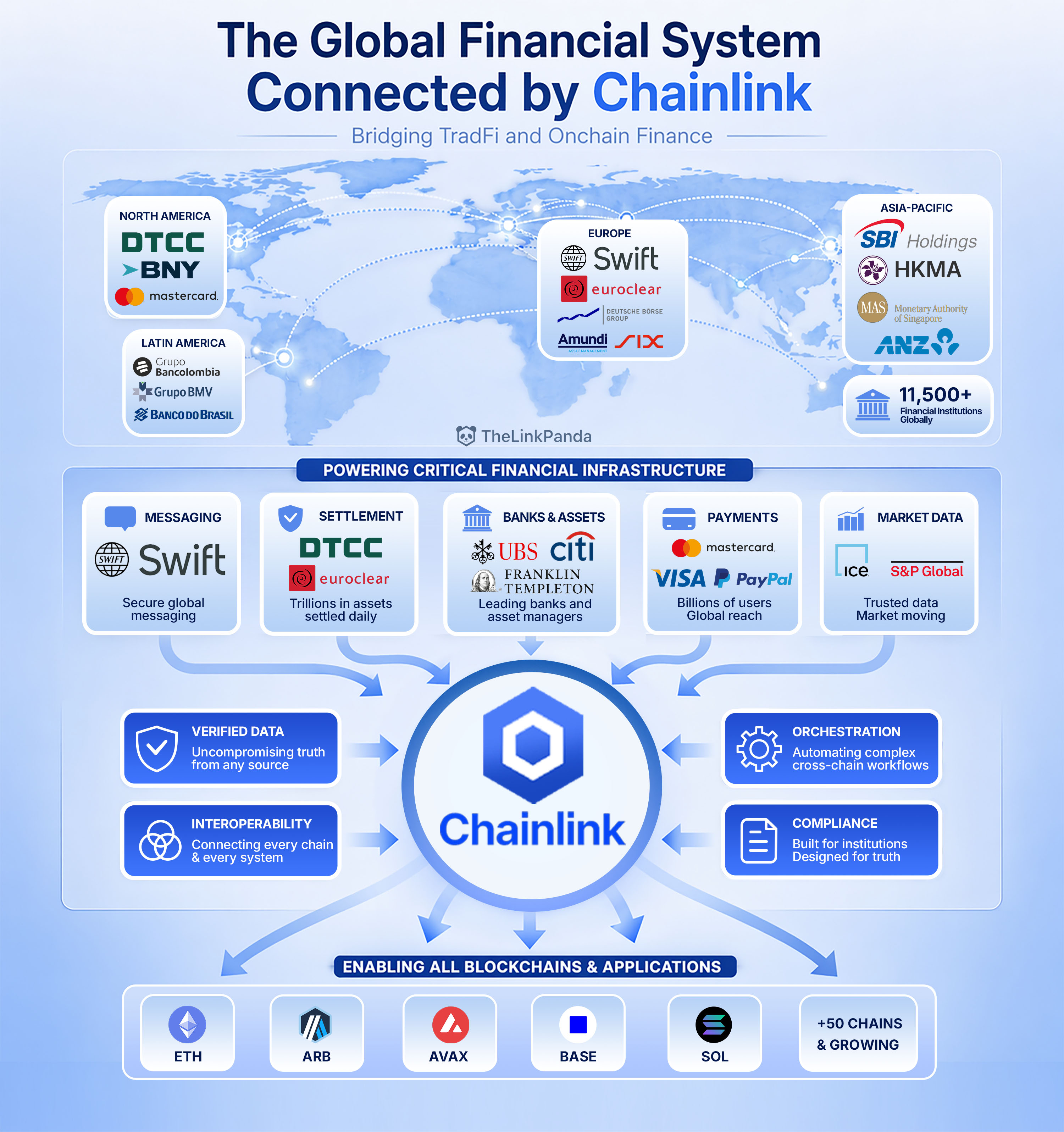
Evidence class: DOCUMENTATION. Joint presentation, 'The Next Generation of Collateral Management: Cross-chain Collateral Mobility', delivered at Sibos 2026 and published by Chainlink. Co-presented by Dan Doney, CTO of DTCC Digital Assets, alongside Sergey Nazarov and Ryan Lovell of Chainlink Labs. The joint authorship is what distinguishes this from Chainlink's own product material: DTCC's CTO is a named presenter. Architecture as specified: • CRE sits offchain and orchestrates, connects existing systems, provides data and enables transactions. • The DTCC Collateral AppChain provides private execution, data-rich asset agreements, institutional reference data and credit facilities, and programmable onchain collateral mobility. • CCIP provides cross-chain connectivity of liquidity and asset movement, and token mobility between public mainnets and the private AppChain. • Public mainnets act as settlement rails; the private AppChain acts as the execution layer. • Collateral agreements enforce Required Value (RQV) onchain, marking collateral to market continuously via real-time price feeds rather than end-of-day batch valuation. The worked flow, specified in eleven steps — a pension fund lender and hedge fund borrower, with Microsoft shares as collateral: 1-3. The pension fund configures financing terms, the Financing Request Contract is deployed, and tokenized USD is deposited. 4-5. The hedge fund connects a wallet, selects the offer, and the lender accepts, forming the loan agreement. 6A-6B. CRE orchestrates creation of the Loan Obligation on Ethereum and triggers the DTCC AppChain to instantiate the corresponding Collateral Agreement. 7-9. Real-time MSFT prices stream to the Pricing Service; MSFT shares are bridged from Ethereum via CCIP to the AppChain; collateral value is checked against ratio and haircuts. 10-11. CRE listens for the agreement to be fully collateralized, then updates the DTCC loan obligation contract and releases the tokenized USD to the borrower. Fulcrum is identified in the diagrams as the Lending Agent User Interface for this flow (see EV-080). Scale figures as presented: $114tn+ DTCC custodied assets; $1.5tn+ native digital assets including $300bn stablecoins; $15tn tokenized money market funds stated as $15B in the source. DTCC's quantified case — every figure below is presented as potential or modelled, not as realised results: • Intraday repo has the potential to reduce daylight overdraft expenses by up to 50%. • In one DTCC model, applying the Collateral AppChain to 15% of wholesale funding exposures reduced required HQLA by 17%, which the presentation states would save billions in operating costs for large banks. • Approximately 15% funding-cost saving for participants, with just-in-time mobilisation replacing just-in-case buffers. • Of an $86tn eligible collateral pool, $34tn is stated as actively deployed. Positioning: the AppChain is described as neutral market infrastructure — not a silo, not a collateral manager, and not tied to one chain, custodian or token agent — with DTCC operating the infrastructure while enabling the collateral manager, custodian or token issuer. Boundary of this entry: this is a conference presentation, not a deployment record. The workflow is demonstrated rather than in production, the economic figures are DTCC's own modelling expressed in conditional terms, and no live transaction volumes are given. Launch timing for the Collateral AppChain is reported elsewhere as Q1 2027.
Why it matters
A document co-presented by DTCC's CTO specifying exactly where Chainlink infrastructure sits in the Collateral AppChain architecture, down to an eleven-step transaction flow naming CRE, CCIP, price feeds and the assets involved. That specificity is rare: most institutional announcements in this database describe intent, while this one describes mechanism. DTCC's modelled figures — a 17% HQLA reduction from applying the AppChain to 15% of wholesale funding exposures, and up to 50% lower daylight overdraft expense from intraday repo — are the clearest articulation of why an institution would adopt this. Graded documentation because it remains a presentation of a demonstrated workflow with a Q1 2027 launch target, not evidence of production use.
Verified — full presentation PDF retrieved and read; co-presented by DTCC's CTO of Digital Assets alongside two Chainlink Labs executives, all named in the deck. Related DTCC Collateral AppChain announcements independently documented in EV-027, EV-034 and EV-042
Topics: DTCC, Collateral AppChain, Fulcrum, CRE, CCIP, Repo, Collateral, Sibos 2026, Securities Lending, Tokenization, HQLA